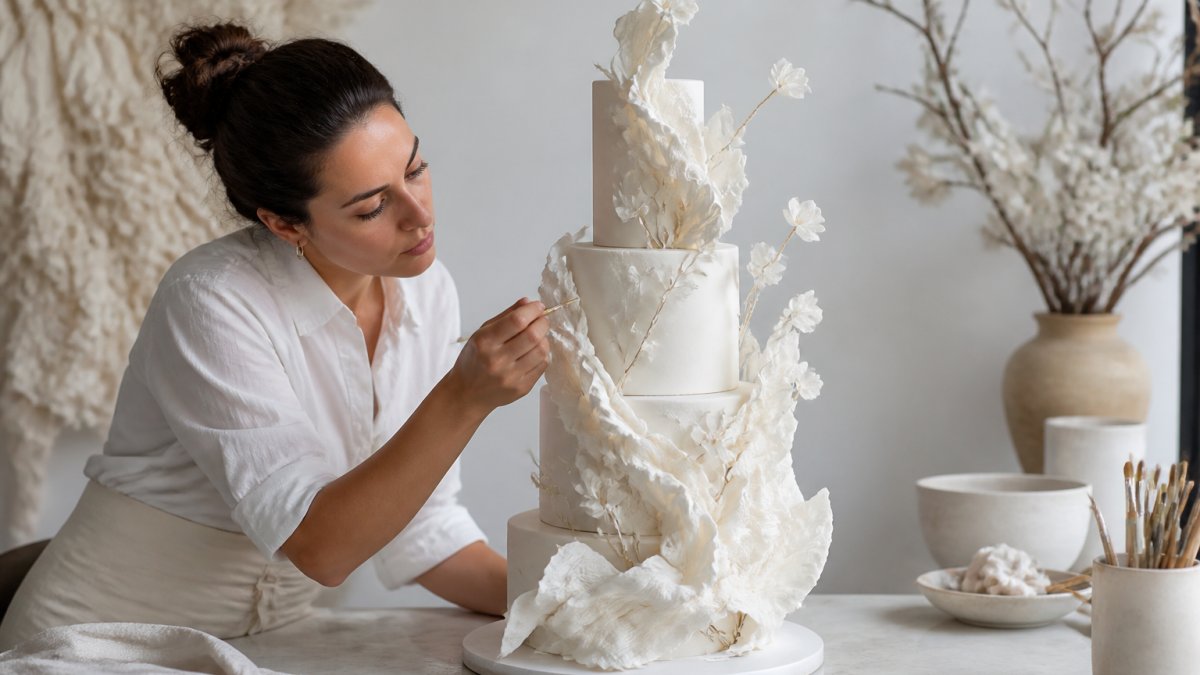
 listicle
Fine Art Cake Design Portfolio Examples
Table of Contents
- What Fine Art Cake Design Means
- Sculptural Wedding Cake Designs That Command Attention
- Floral Cake Design: Botanical Artistry in Sugar
- Cake Design Portfolio Photography: Capturing Edible Art
- Architectural Inspiration and Structural Balance
- Color Palettes, Texture, and Surface Treatment
- Commissioning a Fine Art Cake: What to Expect
- Frequently Asked Questions
Last Updated: October 5, 2026
What Fine Art Cake Design Means
Fine art cake design is the practice of creating edible sculptures that prioritize artistic vision, compositional balance, and visual storytelling as much as flavor and function.
At Violet Cake Co, each cake is a collaborative art piece. The process starts with your aesthetic vision, not a catalog of options, so the cake extends your event's narrative.
What separates fine art cake design from standard custom cakes is the emphasis on sculptural composition, architectural balance, and the artist's hand in every detail, visible in how light plays across hand-sculpted surfaces and how every element serves the visual story.
Sculptural Wedding Cake Designs That Command Attention
Sculptural cakes prioritize form, movement, and three-dimensional presence. These aren't flat designs printed onto fondant; they're architectural pieces where the cake itself becomes the structure.
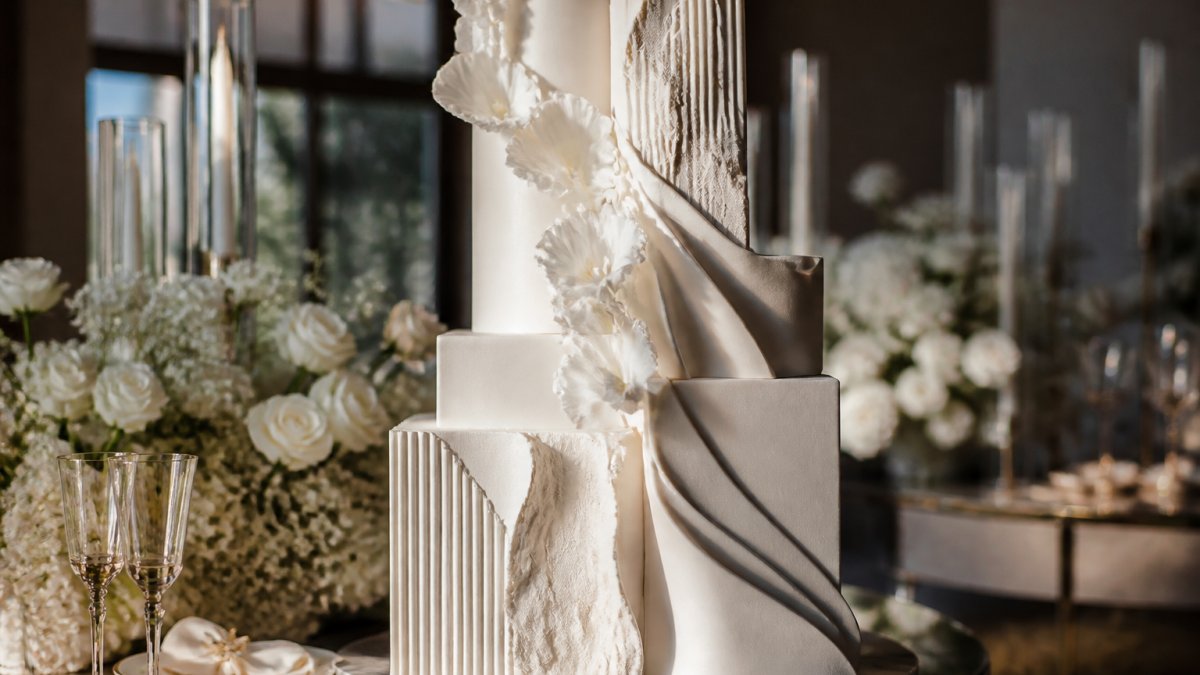
The most compelling sculptural wedding cake designs share core traits: varied tier heights for rhythm, negative space rather than all-over coverage, and texture and shadow for depth.
Proportion matters.
Sculptural cakes often feature minimal or no fondant, exposing the cake texture itself.
Floral Cake Design: Botanical Artistry in Sugar
Floral cake design transforms sugar into delicate botanical forms that rival fresh flowers. Hand-sculpted sugar flowers, piped botanical details, and careful arrangements create a romantic, organic aesthetic.
The most striking floral cake designs use a limited palette, whites, soft pinks, dusty greens, earth tones, to let the botanical forms speak.
Texture matters: hand-sculpted petals show individual variation, while piped details create movement and dimension.
The finest floral cake designs reference real botanical specimens.
Cake Design Portfolio Photography: Capturing Edible Art
How you photograph your fine art cake designs determines how potential clients perceive your work. Portfolio photography is not documentation; it's the primary way your artistic vision reaches people who cannot taste the cake, and a teaching tool most portfolios fail to use.
Organize the gallery by artistic style, not by date
The biggest upgrade to a fine art cake portfolio is grouping images by artistic style rather than reverse-chronological order, letting couples compare like with like. Strong portfolios use four to six style buckets:
- Sculptural, asymmetric tiers, negative space, exposed crumb, dramatic silhouette
- Painterly, hand-painted panels, watercolor washes, brushwork on fondant or wafer paper
- Botanical, hand-sculpted sugar flowers, piped foliage, limited-palette arrangements
Within each bucket, three to five images is enough; more and viewers stop comparing and start scrolling.
Annotate each example with a design breakdown
A caption like "four-tier floral wedding cake" teaches nothing. One naming the inspiration, materials, and signature technique turns the portfolio into a reference library. A useful annotation template covers four lines:
- Inspiration, the painting, building, botanical specimen, or art movement that drove the design
- Materials, fondant, buttercream, wafer paper, isomalt, gumpaste, edible gold leaf, hand-painted cocoa butter
- Technique, hand-sculpted, piped, airbrushed, appliquéd, molded, or painted
- Visual choice, why the palette, proportion, or negative space was handled the way it was
This separates a fine art portfolio from a wedding-cake gallery and gives clients vocabulary to describe what they want.
Write alt text and captions that actually describe the cake
Image descriptions serve screen-reader users and phone skimmers who cannot see fine detail. Alt text should describe the cake, not the keyword: "three-tier ivory fondant cake with hand-sculpted sugar magnolias cascading down the left side and an off-center top tier," not "fine art cake."
A practical rule: if a reader could not identify the cake from the alt text alone, it is too short. Captions then carry the design breakdown, keeping alt text descriptive and captions interpretive.
Lighting, composition, and the shots that sell the work
Professional portfolio photography for fine art cakes requires understanding lighting, composition, and how to convey scale and texture in two dimensions.
Composition matters as much as lighting. A close-up of hand-sculpted details, a full-cake reveal showing proportion, and a styled event shot each tell different stories.
Consider using Behance's bakery portfolio search to see how other artists photograph their work.
Video is increasingly important in portfolio presentation.
Label what is edible and what is not
Sculptural cakes often include non-edible elements, wire stems inside sugar flowers, isomalt shards, painted wafer-paper panels, or structural supports. A portfolio clarifying which components are edible, removed before serving, or decorative-only builds trust with clients and venues; a caption line like "sugar flowers contain wire stems; remove before slicing" signals professional practice.
Architectural Inspiration and Structural Balance
Fine art cake design draws heavily from architecture, not literal replicas, but principles of balance, proportion, and structural integrity.
Architectural inspiration appears in how tiers relate, how negative space functions, and how a silhouette reads across a room.
The strongest architectural cakes maintain visual balance without perfect symmetry.
Structural balance matters practically as well as aesthetically. A cake that looks balanced must actually be balanced, requiring engineering, dowel placement, and weight distribution across tiers.
Color Palettes, Texture, and Surface Treatment
Sophisticated palettes use a limited range, three to four primary colors maximum, letting each hue carry weight.
Texture transforms how color reads. Matte fondant reflects light differently than glossy ganache or exposed buttercream, and hand-sculpted sugar flowers create shadow and dimension flat surfaces cannot.
Surface treatment encompasses the base finish, hand-painted details, and metallic accents. Some fine art cakes feature delicate hand-painting; others use edible gold leaf or metallic dusting.
Commissioning a Fine Art Cake: What to Expect
Commissioning a bespoke fine art cake differs fundamentally from ordering a standard custom cake. It requires clear communication, realistic timelines, and thinking about budget, servings, and logistics before the design conversation starts.
Translate a reference image into a design brief
Most couples arrive with a mood board: a Pinterest pin, a painting, a building photo, a fabric swatch. The designer converts that reference into a buildable brief. A useful brief answers six questions:
- What is the reference, specifically? Not "romantic florals" but "a Dutch still-life painting with dark background and single light source."
- What is the event, date, and venue? Venue ceiling height, table size, and load-in rules all constrain the design.
- How many servings are needed? This determines tier count and diameter, not the other way around.
- What is the budget range? Design ambition and budget must be reconciled on paper, not after the sketch is approved.
- What colors must be avoided or included? Venue linens, florals, and attire often dictate palette limits.
- What is the delivery window? A cake that needs on-site assembly requires a longer venue access window than a drop-off cake.
A skilled fine art cake designer asks these questions during the consultation. A client who arrives with answers moves through design development faster and with fewer revisions.
Questions to ask a cake designer before booking
- How many fine art or sculptural cakes have you completed in the last twelve months?
- Can you show a portfolio organized by style, with captions explaining materials and techniques?
- What is your lead time for a cake of this complexity, and what is your deposit and cancellation policy?
Budget, servings, and the math behind the design
Fine art cakes are priced by the artist's time and skill, not by the slice. Per-serving ranges scale with complexity: simpler buttercream and semi-naked finishes sit lower, while fully sculpted, hand-painted, or heavily floral cakes sit higher. Ask for a per-serving quote and a total, then compare against the number of guests who will actually eat cake.
Serving math is where most couples overshoot. Ask for a serving estimate per tier configuration before finalizing the design.
Budget conversations are easier when the client separates three cost buckets:
- Design and execution, the artist's time, materials, and skill
- Delivery and setup, often a mileage-based or flat fee, higher for on-site assembly
- Rentals and extras, cake stands, acrylic risers, floral additions, or a cutting cake for the kitchen
Timeline, delivery, and venue logistics
Timeline matters. A truly bespoke fine art cake requires adequate lead time, varying by complexity and the designer's schedule.
Delivery and logistics are often overlooked. A fine art cake is delicate, so professional designers typically deliver and assemble on-site, ensuring it arrives in perfect condition and is displayed properly. This service is part of what you're paying for, not an add-on.
Three logistics questions to settle before the design is locked:
- Transport, Does the cake travel assembled, or is it stacked and finished at the venue? Sculptural tiers and tall floral cascades usually require on-site assembly.
- Venue access, What is the load-in window, elevator size, and door clearance? A cake that fits the design may not fit the freight elevator.
- Display environment, Is the cake table in direct sun, near a heat source, or in a high-traffic area? Buttercream, ganache, and isomalt all respond to temperature and humidity.
Food safety and edible versus non-edible elements
Fine art cakes blur the line between sculpture and dessert, and clients should know which side each element sits on. A short pre-event checklist:
- Edible, fondant, buttercream, gumpaste flowers, wafer paper, edible gold leaf, hand-painted cocoa butter, isomalt (edible but hard)
- Non-edible, removed before serving, wire and tape stems inside sugar flowers, foam or styrofoam internal supports, plastic dowels, acrylic or wooden structural elements, non-food-safe paints or dusts
- Decorative only, dried florals not grown for food use, ribbons, and any fresh flowers that may have been treated with pesticides
Ask the designer to mark non-edible elements on the final sketch, and ask the catering team to confirm who removes them before slicing, a short conversation that prevents a long problem.
Pricing for fine art cakes reflects the artist's training, ingredient quality, time invested in design and execution, and specialized skills. When you commission a fine art cake, you're investing in an artist's expertise and vision, not just purchasing dessert, the cost covers consultation, design development, premium ingredients, skilled execution, and professional delivery and setup.
Frequently Asked Questions
What should a fine art cake design portfolio include?
A strong fine art cake design portfolio showcases diversity across multiple styles: sculptural forms, floral compositions, color palettes, and texture treatments. Include high-quality photography of finished cakes from different angles, detail shots of hand-sculpted elements, and context photos showing the cake in its venue setting. Feature a range of cake sizes, flavor profiles, and design themes to demonstrate versatility. Document your design process through sketches or process photos, and include client testimonials that speak to both visual impact and taste. This builds confidence that you can execute both artistic vision and flavor-first execution.
How do you photograph a sculptural cake for a portfolio?
Photograph sculptural cakes with natural or soft diffused lighting to emphasize dimension, shadow, and hand-sculpted detail without harsh glare. Shoot from multiple angles: straight-on, three-quarter view, and close-ups of texture and fine details. Use a neutral background that doesn't compete with the cake's form. Include environmental shots showing the cake in its venue context, as this helps clients envision scale and impact. Avoid heavy filters or editing that distorts color or hides craftsmanship. Professional portfolio photography is an investment that pays dividends, strong images communicate the quality and artistry behind your work.
What makes a cake design look like fine art?
Fine art cake design blends intentional composition, sculptural form, and artistic technique. It prioritizes balance, proportion, and rhythm in the overall structure. Hand-sculpted details, whether floral or architectural, replace mass-produced fondant cutouts. Color palettes are thoughtfully curated rather than randomly selected. Texture and surface treatment create visual interest and depth. The design often draws inspiration from museum art, architecture, or botanical forms. Equally important: fine art cakes taste exceptional. The artistic vision never comes at the expense of flavor and quality ingredients. This combination of visual artistry and culinary excellence distinguishes fine art cake design from purely decorative work.
How can I customize a fine art cake design to match my wedding vision?
The commissioning process begins with a detailed consultation where you share reference images, color inspirations, and your personal story. Bring photos of your venue, florals, and dress to help the designer understand your aesthetic. Discuss flavor preferences, dietary needs, and serving size. A professional fine art cake studio will provide design sketches or digital mockups before production, allowing you to request revisions. Clear communication about your vision, timeline, and budget ensures the final cake reflects your expectations. Be specific about architectural elements, floral styles, or artistic movements that inspire you. Most studios offer a revision process to ensure you're confident in the design before the cake is made.