 How-to
Fashion Into Cake Design: A Step-by-Step Guide
Last Updated: November 22, 2026
Quick Summary
Fashion cake design starts with one reference image, such as a single outfit, runway look, or bridal gown, and pulls the silhouette, fabrics, and color palette from it. You then build the dress cake with a planned internal armature and reproduce the fabric textures in sugar.
- Study one reference image closely instead of merging ten inspiration photos into a busy design.
- Pull three colors from the outfit and match them against real sugar paste samples, not screen colors.
- Plan the internal armature before baking, since cake cannot hold a skirt shape on its own.
- Bake and chill the tiers until firm, because cold cake carves without tearing.
- Keep to one focal point per tier and two textures maximum per cake for elegance.
Table of Contents
- Start With a Reference: Translating Fashion Into Fashion Cake Design
- Fashion-Inspired Cake Ideas: Themes, Silhouettes, and Mood Boards
- How to Make a Dress Cake: Structure, Support, and Safe Construction
- Edible Fabric for Cakes: Reproducing Lace, Pleats, and Texture
- Fashion Cake Decorating Techniques: Accessories, Prints, and Finishing Details
- Keeping a Fashion Cake Elegant Instead of Overly Busy
- Planning Your Couture Cake With Violet Cake Co
- Frequently Asked Questions
Start With a Reference: Translating Fashion Into Fashion Cake Design
Fashion cake design begins with a single reference image, not a sketchbook full of ideas. Pick one outfit, one runway look, or one bridal gown and pull everything from it. At Violet Cake Co, we treat that reference the way a painter treats a subject: study it before you touch the sugar.
The translation happens in three passes. First, note the silhouette: A-line, column, ballgown, mermaid. Second, list the fabrics: lace, satin, tulle, pleats. Third, build the color palette from the garment itself, not from a generic wedding palette.
A common mistake is collecting ten inspiration photos and trying to merge them. That produces a busy cake with no point of view. One reference, studied closely, beats a mood board of fifty.
- Silhouette: the overall shape and proportion
- Fabric: the surface texture you will reproduce in sugar
- Palette: three to five colors lifted from the outfit
- Embellishment: the one detail that makes the look recognizable
Keep the reference image printed and taped up while you work.
Fashion-Inspired Cake Ideas: Themes, Silhouettes, and Mood Boards
Fashion-inspired cake ideas work best when they commit to one theme and one silhouette. A mood board is the bridge between the outfit and the cake: a small collection of images that shows the dress, the fabric close-up, and the color swatches side by side.
Choosing a Runway, Bridal, or Vintage Theme
Runway themes favor bold sculptural shapes and high-contrast palettes. Bridal themes stay softer: ivory, blush, lace, and a clean column or A-line silhouette. Vintage themes pull from mid-century couture, with nipped waists and fuller skirts.
If you are still deciding on a broader direction, our guide to choosing the perfect wedding cake theme walks through how to narrow a theme before you commit to a design.
Building a Cohesive Color Palette From the Outfit
Pull three colors, not seven. Choose the dominant garment color, one accent from the embroidery or trim, and one neutral. Match them against real sugar paste samples, not screen colors. Fondant and buttercream read darker and warmer than a digital swatch.
How to Make a Dress Cake: Structure, Support, and Safe Construction
A dress cake is a sculpted cake shaped like a garment, and it needs real structure before it needs decoration. Cake cannot hold a skirt shape on its own. Build the support first, then carve. The single biggest difference between a dress cake that survives delivery and one that sags is whether the internal armature was planned before the first tier was baked.
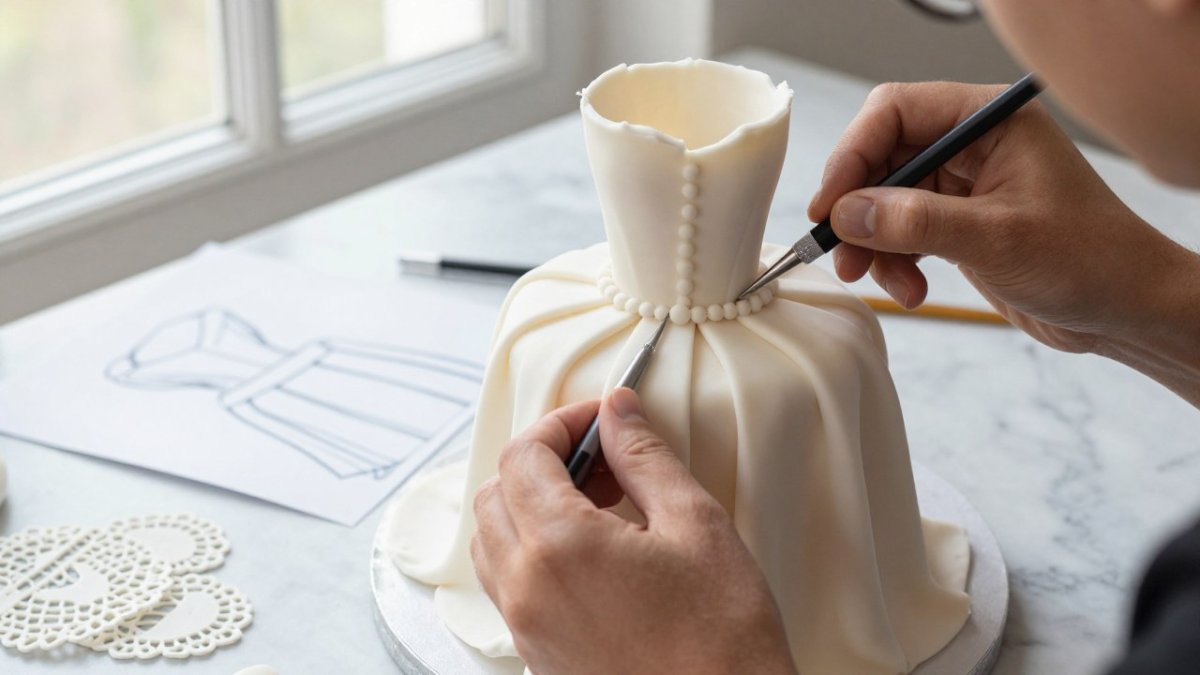
Planning the Armature Before You Bake
Sketch the finished silhouette at full height and mark where the weight sits. A column or mermaid gown carries most of its mass low and centered, so a stacked-and-doweled tier structure works. A ballgown or a gown with a train pushes mass outward and away from the center of gravity, which means the skirt needs a rigid internal frame rather than cake alone. Once the frame can carry the gown’s outward sweep, flower covered cakes offer a way to echo its floral details without adding weight to the structure.
Decide the split between edible and non-edible before baking. That trade-off keeps the shape crisp and reduces the weight the armature must carry. If the entire skirt must be edible, plan a denser cake (a madeira, pound, or mud-style recipe) that carves cleanly and holds a vertical edge.
The Construction Workflow
- Bake and chill the tiers until firm, cold cake carves without tearing.
- Stack and dowel each tier so the weight travels down to the base board, using a central dowel through the full height plus perimeter dowels in each tier.
- Mount the base board on a non-slip mat and confirm the board is larger than the finished skirt footprint.
- Carve the bodice and skirt shape with a serrated knife, working from the top down and checking symmetry against the reference every few cuts.
- Cover with a crumb coat and chill again until the surface is set.
- Install any internal support for an extended skirt or train before the final covering, not after.
Watch out: an unsupported skirt will sag or crack within hours, and a cracked cake cannot be repaired at the venue. A skirt that overhangs the base board by more than a few inches also becomes a lever arm in transport, every bump multiplies at the hem.
Internal Supports, Carving Tolerances, and Stability
Carve the bodice slightly smaller than the skirt so the waist reads as a true cinch. Leave at least a half-inch of cake around any internal dowel so the support does not show through the fondant. For a train, extend the support board under the train and cover the seam with drapery rather than trying to blend cake into cake across a long span.
Sculpting the Bodice, Skirt, and Draping
The bodice is the tightest part of the shape, so carve it slightly smaller than the skirt.
Edible Fabric for Cakes: Reproducing Lace, Pleats, and Texture
Edible fabric for cakes is any sugar medium worked to mimic cloth.
Match the Medium to the Fabric
Start from the reference close-up, not the full outfit. Identify whether the fabric is matte or reflective, structured or fluid, open or solid, then pick the medium that naturally produces that quality.
- Lace: pipe fine royal icing over a lace mat, dry fully, then peel and apply. For a softer look, use a silicone lace mold with fondant or modeling chocolate and press while warm.
- Pleats: press a fondant panel with a ribbed tool while it is still soft, or fold a firm modeling-chocolate panel, set it, then apply it as a pre-formed section.
- Satin: buff fondant to a soft sheen with a dry brush, or use a 50/50 fondant-modeling chocolate blend that takes a smoother finish.
- Tulle: layer fine sugar strands over a pale base, or use a stencil with royal icing for an open-weave effect.
- Quilting: score a diamond grid into fondant, then press a small ball tool into each intersection for the tufted look.
- Leather: mix a little modeling chocolate into fondant for a firmer, slightly waxy surface, then buff and add a stitched edge with a stitching tool.
- Sequins: cut tiny circles from colored fondant or use confetti-style sprinkles, applied in overlapping rows so the surface catches light.
A Repeatable Texture Workflow
Watch out: royal-icing lace applied before it is fully dry will slump and lose its pattern, and pleats pressed into warm fondant will relax back within the hour, set both before they go on the cake.
Combining Textures Without Losing the Look
For readers who want to see how these textures combine with hand-crafted sugar florals, our piece on hand-crafted sugar floral wedding cakes and modern silhouettes shows the finished result.
Match the sugar medium to the fabric you are reproducing, starting from the reference close-up rather than the full outfit.
| Fabric | Medium and method |
|---|---|
| Lace | Pipe royal icing over a lace mat, dry fully, peel and apply |
| Pleats | Press fondant with a ribbed tool while soft, or fold modeling chocolate |
| Satin | Buff fondant with a dry brush, or use a 50/50 fondant-modeling chocolate blend |
| Tulle | Layer fine sugar strands over a pale base, or stencil with royal icing |
| Quilting | Score a diamond grid into fondant, press a ball tool at intersections |
| Leather | Mix modeling chocolate into fondant, buff, add stitched edge |
| Sequins | Cut tiny fondant circles or use confetti-style sprinkles in overlapping rows |
Fashion Cake Decorating Techniques: Accessories, Prints, and Finishing Details
Fashion cake decorating techniques borrow directly from garment finishing. A belt becomes a fondant band. A brooch becomes a sugar topper. A print becomes a hand-painted or stenciled panel on the skirt.
Balance matters more than detail count. If the skirt carries a print, keep the bodice plain. If the bodice has lace, skip the print entirely.
Keeping a Fashion Cake Elegant Instead of Overly Busy
Elegance comes from restraint. The most common failure in fashion cake design is adding one detail too many. When in doubt, remove something.
Three rules keep a cake refined:
- One focal point per tier
- Two textures maximum per cake
- Negative space is part of the design
If you want trend context on restrained, sculptural work, our overview of sculptural wedding cake design trends covers how modern cake artists balance shape and decoration. And if you are exploring how silhouettes are actually built, modern cake silhouettes in our studio's work shows the construction behind the look.
Planning Your Couture Cake With Violet Cake Co
A couture cake is a commissioned piece, so the planning process matters as much as the decorating. Start with your reference image and your outfit details. Bring the fabric swatch if you can.
We build each design around your story, with hand-crafted sugar florals and flavor-first recipes. Our founder, Malissa, is a graduate of USC's Roski School of Fine Art. You can personalize your wedding cake with Violet Cake Co through a professional consultation and design process.
Lead time depends on complexity and date availability, so reach out early. Pricing depends on size, detail, and delivery, and current pricing is on our website.
Fashion and cake reward the same discipline: a clear reference, strong structure, and restraint in the finishing. If you are ready to turn a garment into a centerpiece, Violet Cake Co can design a bespoke cake with hand-crafted sugar florals, sculptural silhouettes, and flavors built to match the look. Get started with Violet Cake Co and commission a cake that carries your vision from sketch to table.
Frequently Asked Questions
How do you make a fashion-inspired cake without it looking busy?
Pick one focal reference and edit everything else out. Choose a single silhouette, a two- or three-color palette pulled from the outfit, and one statement detail. Keep the remaining tiers smooth and quiet so the eye has somewhere to rest. Proportion matters too: a large skirt tier balanced by a slimmer bodice reads as couture, while cluttered accessories on every tier read as costume.
What details from an outfit work well on a fashion cake?
The most transferable details are the ones with clear shape: a sweetheart neckline, a corset seam, a pleated skirt, a lace sleeve, a sash, or a jeweled belt. Skip anything that depends on movement to read, and translate it into a static suggestion instead.
How do you match a cake design to an outfit or wedding palette?
Bring fabric swatches or high-resolution photos in natural light so colors can be matched carefully. Limit yourself to two or three colors drawn from the garment, and use a neutral base tier to keep the palette from overwhelming the design.
How far in advance should you order a sculpted fashion cake?
Book as early as your venue and guest count are confirmed, since peak wedding season fills quickly. Ask about lead time when you request a quote, and confirm delivery logistics at the same time.