 How-to
How to Assess Wedding Cake Flavor Quality
Table of Contents
- What You'll Need for a Wedding Cake Tasting
- Wedding Cake Tasting Tips for a Fair Evaluation
- How to Judge Sponge, Filling, and Frosting Balance
- Wedding Cake Flavor Combinations That Work
- Assessing Flavor Quality in Wedding Cake Samples
- Questions to Ask a Wedding Cake Baker
- Your Wedding Cake Tasting Checklist
- Conclusion
- Frequently Asked Questions
Last Updated: October 9, 2026
What You'll Need for a Wedding Cake Tasting
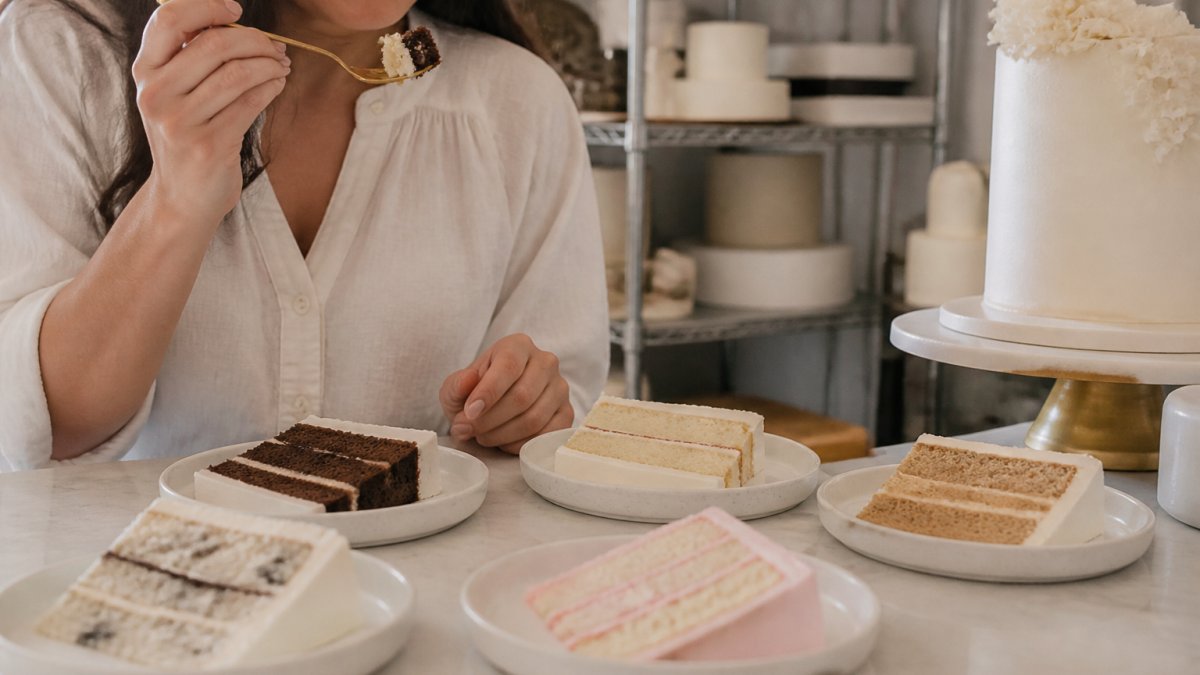
A wedding cake tasting is a structured evaluation, not a casual dessert break. The right setup lets you judge wedding cake flavor quality instead of guessing from a single bite.
Here is what to bring:
- A printed scorecard (more on this below)
- Water and plain crackers to reset your palate
- A pen for notes on each sample
At Violet Cake Co, we treat every tasting as a working session.
Plan to taste no more than four to six flavors per session. Your palate tires fast, and flavors start to blur after that.
Wedding Cake Tasting Tips for a Fair Evaluation
Fair evaluation comes down to one rule: taste every sample the same way. Same bite size, same order, same scoring method. That consistency is what separates a real assessment from a pleasant afternoon.
Work through these steps:
- Taste the sponge alone before the frosting touches it.
- Note the first impression in one word.
- Score sweetness on a 1-5 scale.
- Score texture on a separate 1-5 scale.
- Sip water between every sample.
- Write your notes before discussing the cake with your partner.
Most couples skip step one. That is a mistake. The sponge carries the flavor; frosting is the frame.
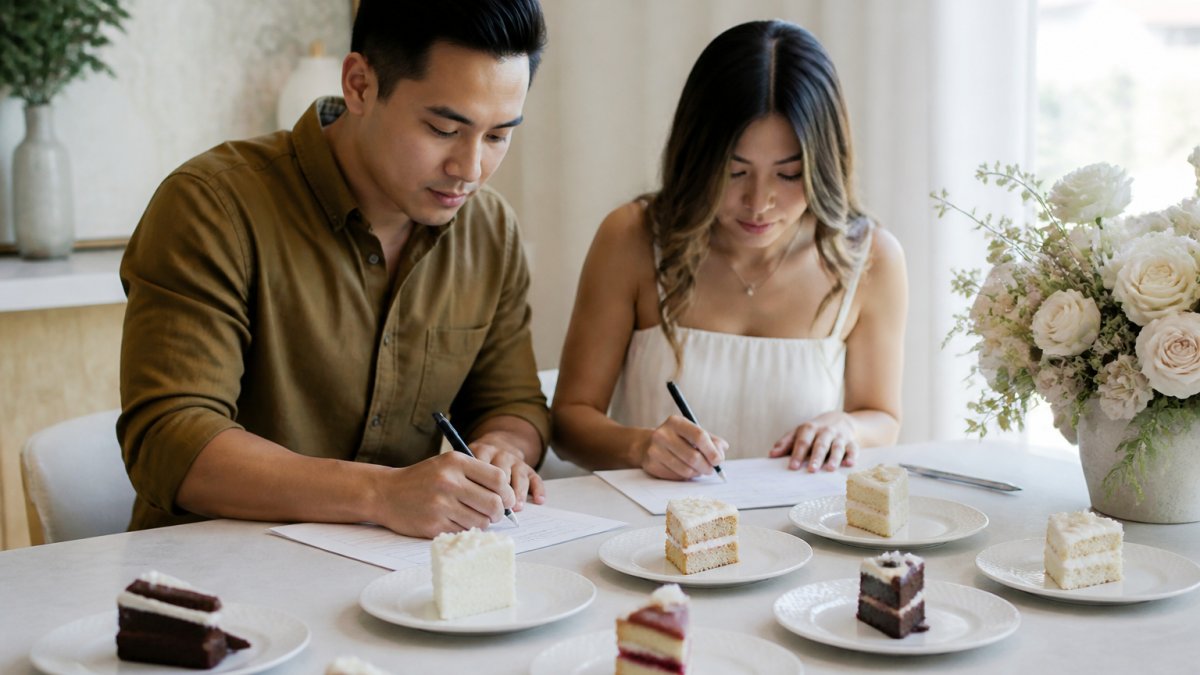
Blind Tasting and Side-by-Side Scoring
Blind tasting removes the biggest bias in the room: design. A sculptural cake can make you swear the flavor is better than it is.
Ask your baker to label samples with numbers only. Taste them side by side, not one after another. Then rank each on three lines:
| What to Score | 1 (Weak) | 3 (Solid) | 5 (Excellent) |
|---|---|---|---|
| Sponge texture | Dry or dense | Moist, even crumb | Tender, fine crumb |
| Sweetness | Cloying or flat | Balanced | Bright and clean |
| Filling | Barely there | Noticeable | Distinct and layered |
| Finish | Coats the mouth | Clean | Clean and lingering |
This method is the single fastest way to compare wedding cake flavor options without letting looks decide for you.
How to Judge Sponge, Filling, and Frosting Balance
Balance is the hardest thing to judge and the most important. A cake fails when one layer shouts over the others. The fix is to stop scoring the cake as a whole and score each component on its own axis, then check whether the components are pulling in the same direction.
Use a three-axis read on every sample:
- Sponge as the base. Press a fork into the crumb. It should spring back and hold moisture without feeling wet or tacky. A dry crumb usually means the cake was overbaked or sat too long; a gummy crumb usually means underbaking or too much liquid. The sponge should taste like something on its own, vanilla, almond, brown butter, cocoa, not just "cake."
- Filling as the accent. The filling should add a distinct note, not just sugar. Fruit fillings should taste like fruit, not like fruit-flavored jam. Nut or cookie-butter fillings should bring depth without turning gluey or gritty. If you cannot name the filling blind, it is not doing its job.
- Frosting as the frame. Buttercream should feel silky, not greasy or gritty. It should hold its shape at room temperature without weeping or sliding. If the frosting is the only thing you taste, the balance is off, the frosting is dominating rather than framing.
A well-executed cake lets all three layers speak in turn. That is the mark of quality, and it is what makes a cake memorable rather than just pretty.
The three failure modes to name out loud
Most unbalanced cakes fail in one of three predictable ways. Naming the failure mode is faster than describing it.
- Overly sweet. The frosting or filling carries most of the sugar, and the sponge disappears underneath it. Common with American buttercream paired with a delicate sponge.
- Overly rich. Fat and sugar stack across all three components, think chocolate sponge, ganache filling, and chocolate buttercream. Rich is fine for a small slice at an evening reception; it is punishing as a full serving.
- One-note or dry. The sponge is the only thing you taste, or the crumb is dry enough that the filling and frosting cannot compensate. Dry cake reads as stale even when it is fresh.
A quick ratio check
You do not need a scale, but you do need to notice proportions. On a typical slice, the sponge should be the largest component by volume, the frosting a thin even layer, and the filling a distinct band, not a flood. If the filling is thicker than the sponge, the cake will read as a pudding cup rather than a cake.
How to spot a combination that will not scale
A flavor that works in a 2-inch sample can fail in a 6-inch tier. Two reasons: surface area to volume changes, and the ratio of frosting to sponge shifts as tiers get larger.
If you are comparing two bakers, score balance on the same 1-5 scale you use for texture and sweetness, and write the failure mode next to the score.
Wedding Cake Flavor Combinations That Work
Good flavor combinations follow a simple logic: one base, one accent, one texture. Skip that structure and you get a muddled bite. The list below is not a menu to copy, it is a set of worked examples you can use to judge any combination a baker proposes.
These pairings hold up well:
- Vanilla bean sponge with raspberry filling and light buttercream. Classic, clean, and hard to get wrong. The raspberry is the accent; the vanilla is the base; the buttercream is the frame.
- Chocolate cake with salted caramel and espresso buttercream. Rich and decadent, best for evening receptions. The salt in the caramel keeps the sweetness from flattening.
- Almond sponge with cherry filling and cream cheese frosting. A softer, fruit-forward profile. The cream cheese adds tang, which keeps the cherry from reading as candy.
For couples who want unique flavors, layer a familiar base with one unexpected accent. Guests remember a surprise, not a gimmick.
How to judge a combination you have never tasted
Before you taste, ask three questions about any proposed pairing:
- Is there a clear base? One flavor should be the anchor. If two flavors are fighting to be the base, the bite will read as muddled.
- Does the accent contrast or echo? Contrast works when the accent cuts the base, citrus against chocolate, salt against caramel, tart fruit against sweet sponge. Echo works when the accent deepens the base, espresso against chocolate, almond against vanilla. Both are valid; a combination that does neither is usually just sweet.
- Is there a texture change? A crunch, a fruit piece, a ganache band, a nut praline. Texture is what keeps a bite from becoming monotonous after the third forkful.
If a proposed combination fails any of these three, ask the baker what the intended effect is. Sometimes there is a reason, a subtle echo can be intentional, but a baker who cannot articulate the logic is guessing.
Seasonal and guest-facing adjustments
Season affects how a flavor reads. A heavy chocolate-and-caramel cake that feels right in November can feel cloying in July; a lemon-and-berry cake that feels bright in June can feel thin in December.
Guest preferences matter too, but they should not override the couple's. The practical move is to pick one crowd-pleasing tier and one personal tier. A vanilla or chocolate tier covers the widest range of guests; the personal tier is where you take the risk.
Assessing Flavor Quality in Wedding Cake Samples
Quality shows up in small details. Fresh-baked cake has a clean aroma and an even crumb. Older samples taste flat and dry at the edges.
Check these quality markers:
- Does the sponge smell fresh, or slightly stale?
- Is the crumb even, or are there dry pockets?
- Does the frosting hold its shape without weeping?
- Do the real ingredients come through, or just sugar?
Ask your baker when the sample was baked. A sample more than a day old is not a fair test of the recipe.
Tasting Logistics and Sample Freshness
Sample freshness is the detail most couples overlook. Cake is best within a day of baking, and frosting can separate if it sits too long.
If your baker ships samples, ask how they are packed and how fast they arrive. If you taste in person, ask for samples cut that day.
Dietary needs matter here too. If you or your guests avoid gluten, dairy, or nuts, ask for allergen-aware samples.
Questions to Ask a Wedding Cake Baker
The right questions reveal how a baker works and how your cake will hold up.
- How do you keep the sponge moist under fondant or heavy frosting?
- Can you adjust sweetness without losing flavor balance?
- How do you handle gluten-free, dairy-free, or nut-free requests?
- What is your lead time for a fully custom design?
A baker who answers with specifics is a baker who has done the work. Vague answers are a warning sign.
Your Wedding Cake Tasting Checklist
Use this checklist at every tasting. Print it, and score each sample as you go.
- Sponge tasted alone before frosting
- Sweetness scored 1-5
- Texture scored 1-5
- Filling judged for distinct flavor
This checklist turns a fun afternoon into a real decision. It also gives you a record to compare if you taste with more than one baker.
For more on how professional bakers approach flavor and design, see USDA food safety guidance on safe handling and FDA guidance on food allergens.
Conclusion
Choosing a wedding cake flavor is emotional, but judging quality does not have to be. A repeatable method, honest scoring, and a few sharp questions will tell you more than any single beautiful bite.
At Violet Cake Co, we build every cake around flavor first. Our bespoke, handcrafted designs, signature floral-inspired aesthetic, and professional consultation process mean your centerpiece tastes as good as it looks.
START YOUR CAKE DESIGN
Frequently Asked Questions
What should you look for when tasting wedding cake samples?
Focus on four things: sponge moisture (it should spring back, not crumble), frosting sweetness (buttercream should taste like butter, not powdered sugar), filling flavor (it should be identifiable, not just sweet), and overall balance (no single element should overpower the others). Take small bites, let each component sit on your tongue briefly, and write notes immediately. A wedding cake tasting checklist helps you compare samples fairly instead of relying on memory.
How can you tell if a wedding cake uses high-quality ingredients?
High-quality wedding cake flavor starts with real ingredients. Vanilla bean should show visible specks and taste floral, not artificial. Buttercream made with real butter has a creamy mouthfeel and melts at body temperature; versions made with shortening leave a waxy coating. Fruit fillings should taste like actual fruit, not jam from a jar. Ask the baker directly about their ingredients, and pay attention to whether the sponge tastes fresh-baked or has a refrigerated, stale edge.
How do you compare cake, filling, and frosting flavors?
Taste each component separately first, then together. The sponge sets the base texture; the filling adds moisture and a flavor accent; the frosting brings sweetness and structure. A well-executed cake has flavor balance, meaning no single layer dominates. If the buttercream is so sweet it masks the vanilla bean sponge, or the filling is so tart it overwhelms the chocolate, the proportions are off. Note which pairings feel harmonious and which fight each other.
How many wedding cake flavors should you offer?
Most couples choose two to three flavors for a wedding reception. One classic flavor (like vanilla bean or chocolate) satisfies traditional guest preferences, while one unique flavor (like cookie butter or a fruit-forward combination) adds personality. If your guest list is large or diverse, three tiers with different flavors gives wedding guests options without overwhelming the kitchen or your budget. Discuss tier-by-tier flavor options with your cake baker during the tasting.