 Listicle
9 Vintage Piping Styles for Modern Wedding Cakes
Last Updated: November 12, 2026
Quick Summary
Vintage piping is a set of hand-piped buttercream techniques, not a single look, so you can scale it from a single bead border to a fully overpiped Lambeth tier. For modern weddings, choose one technique as the hero and remove the rest. Tone-on-tone palettes and oversized ruffles keep the reference subtle and contemporary.
- Simple vintage piping uses one base border, scattered dots, or a small centered monogram.
- Lambeth piping suits two-tier cakes better than five-tier because dense piping needs proportion.
- Hold the bag at roughly a 45-degree angle for shells and borders, closer to 90 for dots.
- Oversized ruffles read as modern sculpture, while tiny tight ruffles read as 1980s.
- Heavily piped tiers need more support and a longer setup window for transport.
Table of Contents
- Why Vintage Piping Still Belongs at Modern Weddings
- Simple Vintage Wedding Cake Piping for Understated Elegance
- Lambeth Piping Wedding Cake: The Overpiped Showstopper
- Wedding Cake Piping Techniques: Tips, Pressure, and Rhythm
- Ruffles, Swags, and Scrollwork: The Ornate Classics
- Piped Borders, Edging, and Floral Details
- Making Vintage Piping Work for Minimalist Weddings
- Start Your Cake Design with Violet Cake Co
- Frequently Asked Questions
Why Vintage Piping Still Belongs at Modern Weddings
Vintage piping styles for modern weddings are back, and not as a nostalgia exercise. Hand-piped buttercream detail reads as both heritage and contemporary, which is why it keeps appearing in wedding cake design.
Here is the part most guides miss: vintage piping is a set of techniques, not a single look. A tight shell border and an overpiped Lambeth tier come from the same bag of tricks. What changes is how much you use and where you stop.
Below, we break down nine vintage piping styles, how each one works, and how to adapt it for a modern wedding. You will also find a technique guide, a style-by-venue table, and the practical considerations most inspiration posts skip.
Simple Vintage Wedding Cake Piping for Understated Elegance
Simple vintage wedding cake piping suits couples who want a nod to tradition without a fully ornate cake. Think a single piped border at the base of each tier, delicate swiss dots scattered across a smooth buttercream finish, or a fine bead of pearls along the top edge.
The restraint is the point. A two-tier cake with one hand-piped border and a soft finish looks intentional. The same border repeated on every tier edge starts to look busy.
Three simple approaches we recommend:
- Single base border: one shell or bead border at the bottom of each tier, nothing else.
- Scattered dots: small piped dots in a loose, irregular pattern across one tier face.
- Monogram accent: a hand-piped monogram on the top tier, kept small and centered.
Restrained piping keeps less surface detail exposed, which can help in warm conditions.
Lambeth Piping Wedding Cake: The Overpiped Showstopper
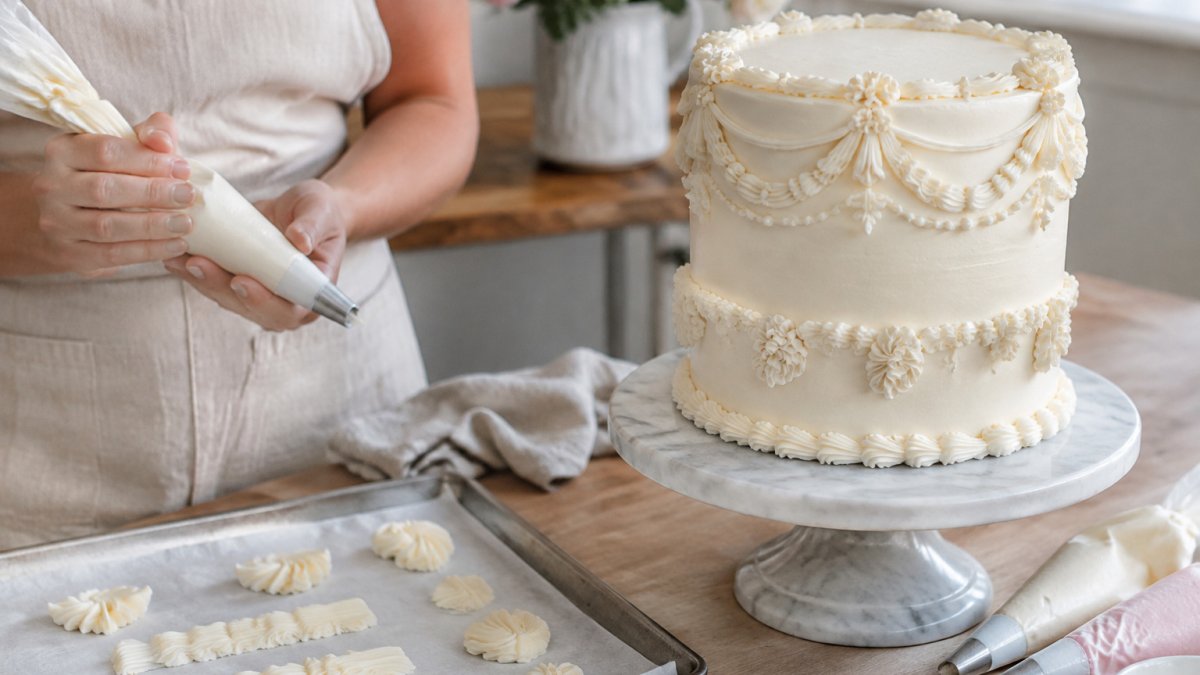
Lambeth piping wedding cake is the maximalist end of the spectrum: tier upon tier of overlapping scrollwork, scalloped swags, and dimensional borders piped directly onto buttercream.
Done well, a Lambeth cake looks like carved plaster. Done poorly, it looks like a piping practice sheet. The difference is rhythm and spacing, which we cover in the next section.
Where this style fits: black-tie receptions, grand hotel ballrooms, and couples who want the cake to be a centerpiece rather than a background detail. It also suits a two-tier cake better than a five-tier, because the density of piping needs proportion.
You can see how we translate vintage piped and artistic designs into real weddings through our custom artistic cake designs for weddings.
Wedding Cake Piping Techniques: Tips, Pressure, and Rhythm
Wedding cake piping techniques come down to four controls: tip choice, icing consistency, bag pressure, and the rhythm of your hand. Get those right and the pattern looks deliberate. Get them wrong and no amount of practice on a sheet pan fixes the cake. Consistency is a control that is often underestimated, because a tip that works on a practice board can fail on a chilled tier if the buttercream is too warm.
Piping tips and what they do:
| Tip Type | Common Sizes | Best For | Effect |
|---|---|---|---|
| Round tip | #2 to #12 | Beads, dots, monograms, fine lines | Clean, precise lines |
| Star tip (open) | #18 to #32 | Shells, rosettes, borders | Ridged, dimensional texture |
| Star tip (closed) | #4B to #8B | Swirls, drop flowers | Sharper, more defined ridges |
| Petal tip | #101 to #125 | Ruffles, swags, draped effects | Soft, fabric-like folds |
| Leaf tip | #65 to #352 | Piped leaves, floral accents | Natural, tapered shapes |
| Basketweave tip | #44 to #48 | Woven borders, lattice | Crosshatched texture |
Icing consistency: the same tip produces different results depending on how stiff the buttercream is. For shells and borders, you want a medium-stiff consistency that holds a ridge without tearing.
Pressure: steady, even squeeze. Stop pressure before you lift the tip, or you get a tail on every shell.
Bag angle: hold the bag at roughly a 45-degree angle to the cake surface for shells and borders, and closer to 90 degrees for dots and beads.
Rhythm: count it. Most piped borders follow a consistent beat, roughly one shell per count.
Temperature: buttercream that is too warm will not hold a peak. Work in small batches and keep the bag cool.
Tip-to-effect quick chart:
| Desired Effect | Tip | Consistency | Technique |
|---|---|---|---|
| Beaded border | Round #4 to #8 | Stiff | Even pressure, stop before lift |
| Shell border | Open star #18 to #32 | Medium-stiff | 45-degree angle, one count per shell |
| Ruffle cascade | Petal #101 to #125 | Medium-soft | Wiggle wrist, overlap each fold |
| Swag garland | Petal #101 to #104 | Medium | Arc motion, release at the end |
| Piped monogram | Round #2 to #4 | Stiff | Pipe on a flat surface, transfer chilled |
| Basketweave | Basketweave #44 to #48 | Medium-stiff | Vertical lines first, horizontal over |
If you want a practical way to turn piping inspiration into a brief for your own cake, our wedding cake design checklist walks through the questions to answer before your consultation.
Ruffles, Swags, and Scrollwork: The Ornate Classics
Ruffles, swags, and scrollwork are the three ornate classics that define vintage cake decoration. Ruffles use a petal tip to create cascading fabric-like folds. Swags are curved garlands piped in repeating arcs around a tier. Scrollwork is the freestyle, hand-piped vine and curl pattern that fills open space.
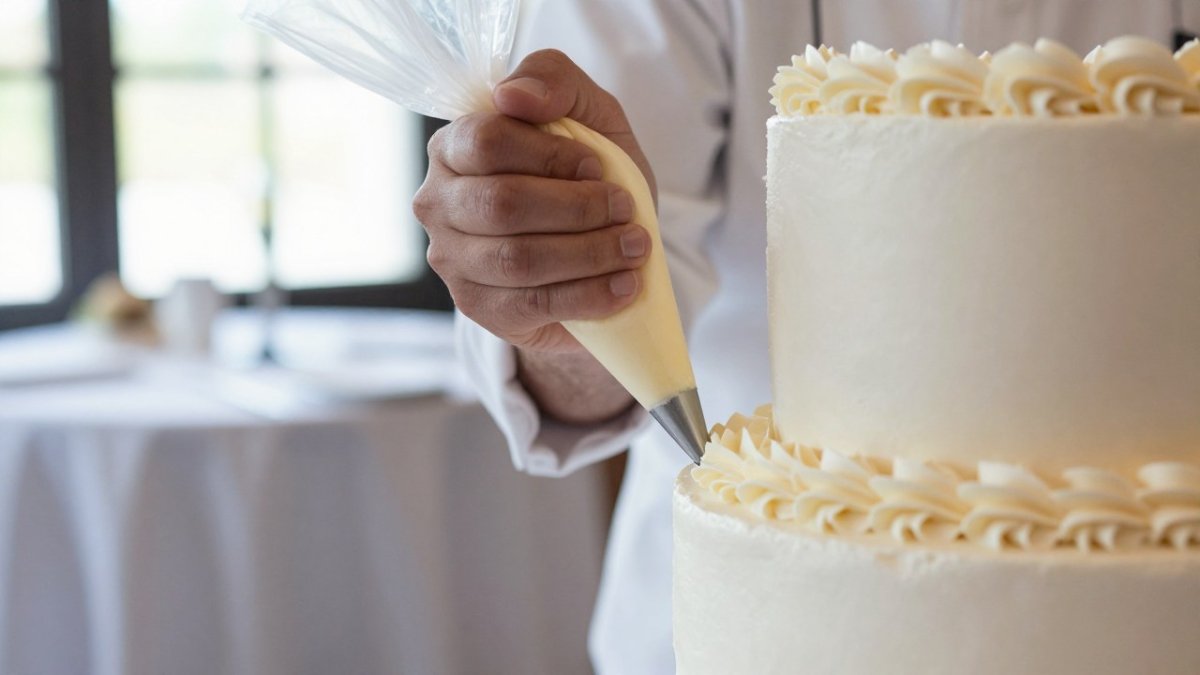
The trick to keeping these from looking dated is scale. Oversized ruffles read as modern sculpture. Tiny, tight ruffles read as 1980s. Swags work best in a single row rather than stacked rows. Scrollwork benefits from negative space: leave gaps between the curls so the pattern breathes.
A common mistake is combining all three on one tier. Pick one as the hero and let the others support it.
Piped Borders, Edging, and Floral Details
Piped borders and edging do the structural work on a vintage cake. They frame each tier, hide the seam where tiers meet, and give the eye a place to rest between ornate sections.
The most useful borders for modern weddings:
- Shell border: classic, dimensional, works on any tier count.
- Beaded border: small round pearls, ideal for minimalist designs.
- Reverse shell: a subtler, flatter variation of the classic shell.
- Rope border: twisted piping that suits rustic and garden venues.
Floral details are where vintage piping meets modern floral design. Hand-piped buttercream flowers, sugar florals, and fresh blooms can all sit alongside piped borders. The key is matching the scale of the flower to the scale of the border.
For couples who want flowers integrated into the piping rather than added on top, our wedding cake floral designs show how painted and piped florals can carry the whole design.
Making Vintage Piping Work for Minimalist Weddings
Vintage piping and minimalism are not opposites. The adaptation is about editing. A minimalist wedding cake with vintage piping usually keeps one technique and removes everything else.
How to adapt ornate piping for a clean, modern look:
- Choose one tier for detail. Pipe the bottom tier, leave the upper tiers smooth. This anchors the design without overwhelming it.
- Switch to tone-on-tone. White piping on white buttercream gives texture without visual noise. Ivory on ivory and soft pink on soft pink work the same way.
- Reduce the border to a single line. A bead border instead of a shell border reads quieter, and a single row instead of stacked rows keeps the edge clean.
- Use a soft palette. White, ivory, and soft pink piping keeps the vintage reference subtle. A single metallic accent, such as a thin gold bead line, can bridge vintage and modern without tipping into ornate.
- Scale up, not out. Oversized ruffles or a single large swag read as modern sculpture, while tiny tight repeats read as period decoration.
Matching the style to the venue and palette:
| Wedding Setting | Piping Approach | Palette |
|---|---|---|
| Minimalist ballroom | Single bead border, tone-on-tone | White, ivory |
| Garden or vineyard tent | One swag row, piped leaves | Soft pink, sage |
| Modern gallery or loft | Oversized ruffle on one tier | White with metallic accent |
| Black-tie hotel | Lambeth detail on bottom tier only | Ivory, soft blush |
Trade-offs to weigh:
- Detail versus stability. More piping means more surface area that can slump in warm weather. If your venue runs warm or the cake will sit out during a long reception, keep detail low on the cake and skip delicate vertical piping.
- Detail versus budget. Piping complexity affects labor and timeline. A single border and scattered dots cost less to produce than a full Lambeth tier, and the pared-back version often photographs just as well in a minimalist room.
- Detail versus dietary and transport needs. Buttercream piping is the most common choice for vintage looks, but couples with dietary restrictions may need a different frosting base, which changes how sharply the piping holds. Transport also matters: heavily piped tiers need more support and a longer setup window.
This is the approach we take most often for modern minimalist receptions. The piping is there, but it whispers. If you want to see how that balance plays out in current design, our modern floral cake designs for 2026 show the palette and floral direction that pairs well with pared-back piping.
Best for: couples who love vintage detail but want a clean, contemporary cake. Skip if: you want the cake to be the loudest element in the room.
Start Your Cake Design with Violet Cake Co
The hardest part of vintage piping is not choosing a style. It is knowing which style fits your venue, your palette, and your guest count without seeing it on a cake first.
Violet Cake Co is a couture cake studio founded by Malissa, a graduate of USC's Roski School of Fine Art. The studio creates bespoke, handcrafted cakes with a focus on flavor-first recipes and hand-crafted sugar florals.
If vintage piping is on your shortlist, start by browsing our vintage and Lambeth-style wedding cakes. Then book a consultation to discuss the piping style for your venue and palette.
Vintage piping rewards couples who plan the detail before the design.
Frequently Asked Questions
What is vintage piping on a wedding cake?
Vintage piping is hand-piped buttercream or royal icing decoration inspired by mid-century cake styles: swags, scrollwork, ruffles, borders, and Lambeth-style overpiping. It relies on a steady hand and a small set of piping tips rather than fondant cutouts or molds. Modern versions keep the technique but soften the palette and scale, so the result reads as delicate and intentional rather than heavy. Violet Cake Co builds these details into bespoke designs so the piping matches each couple's story.
What piping styles are popular for vintage wedding cakes?
The most requested styles include Lambeth overpiping, buttercream ruffles, swags and scrollwork, piped borders and edging, and small frosting flowers. Simple vintage piping, which uses one or two motifs repeated across a tier, is growing fast because it photographs well and suits smaller two-tier cakes. Couples often pair white cake with soft pink or grey piping for a softer finish. Ask your baker which styles hold up best in warm weather and during transport before you commit.
How can you make a vintage-style wedding cake look modern?
Three moves do most of the work. First, reduce the pattern: pick one motif, such as a single piped border or a row of small shells, instead of layering several. Second, shift the palette to white, soft pink, or grey piping on a white cake. Third, change the silhouette to a clean two-tier or a sculptural offset stack. Piping techniques stay the same; the restraint is what makes it read as contemporary.
Can vintage piping work on a minimalist wedding cake?
Yes, and it is one of the most effective ways to add character without clutter. Keep the cake smooth and undecorated on most of the surface, then pipe a single detail: a fine beaded border at the base, a delicate monogram, or one band of scrollwork on the top tier. The imperfect hand of hand-piped work gives a soft finish that a printed or stenciled design cannot match.