 Ultimate guide
Why Custom Menu Design Matters for Private Events
Last Updated: November 17, 2026
Quick Summary
Custom menu design is the deliberate shaping of every course, ingredient, and printed detail around one specific occasion and the people in the room. It matters because a private event succeeds on how personally guests feel considered, and that specificity is what guests remember.
- A custom menu can reference a grandmother's recipe, a proposal, or a guest who cannot eat gluten.
- Ask three questions before any tasting to generate two or three anchor dishes.
- A guest should understand every dish in under ten seconds, so readability beats decoration.
- Collect dietary needs at RSVP with specific categories rather than free text.
- Lock the menu concept, caterer, and cake designer four to six months out.
Table of Contents
- Why Custom Menu Design Sets Private Events Apart
- How a Custom Menu Reflects the Host and Guest of Honor
- Luxury Wedding Menu Design Ideas That Tell a Story
- Best Practices for Event Menu Layout, Readability, and Accessibility
- Coordinating Cake Design With Event Menus for a Cohesive Look
- Building a Dietary and Allergen Communication System
- A Planning Timeline and Budget Framework for Custom Menus
- Start Your Cake Design With a Custom Menu in Mind
- Frequently Asked Questions
Why Custom Menu Design Sets Private Events Apart
Custom menu design is the deliberate shaping of every course, ingredient, and printed detail around one specific occasion and the people in the room. It matters because a private event succeeds on how personally guests feel considered. A cake designed around a couple's story lands differently than a generic showpiece.
Here's the distinction most planners miss. A restaurant menu serves everyone who walks in tonight. A custom menu serves the forty people who were invited, and it can reference a grandmother's recipe, a proposal in a garden, or a guest of honor who cannot eat gluten. That specificity is what guests remember.
Below, we break down how to build one, from storytelling to budget to the printed layout.
| Element | Generic Event Menu | Custom Menu |
|---|---|---|
| Course structure | Fixed package | Built around the host's story |
| Dietary handling | One alternate plate | Planned per guest need |
| Printed menu | Template | Designed to match décor |
| Dessert | Standard sheet cake | Bespoke centerpiece |
How a Custom Menu Reflects the Host and Guest of Honor
A menu becomes personal the moment it answers a question about the host: where they grew up, what they celebrate, who taught them to cook. Start there, not with the caterer's package list.
Ask three questions before any tasting. What flavors does the guest of honor request every birthday? Is there a regional dish or family recipe that carries meaning? What should a guest feel when the first course arrives? The answers usually generate two or three anchor dishes, and the rest of the menu builds around them. Once those anchor dishes are clear, weighing tasting menu vs à la carte helps determine how much room the rest of the meal should leave for choice.
Personalization is not nostalgia for its own sake. A menu that reflects the host gives guests a conversation starter and gives the event a point of view. For a milestone anniversary, that might mean a dessert course echoing the couple's original wedding flavors.
Luxury Wedding Menu Design Ideas That Tell a Story
Luxury wedding menu design ideas work best when they treat the menu as a narrative with a beginning, middle, and end. Course selection is your plot: a light, bright opening; a richer center; a dessert that closes the loop.
Try these approaches:
- Name courses after meaningful places or moments, described in a sentence rather than a label.
- Pair seasonal ingredients with one unexpected element, such as a local fruit in a savory course.
- Let the dessert echo the couple's story, whether through flavor, color, or floral detailing.
- Keep the menu itself short. Six well-chosen passed bites read as more considered than twelve scattered ones.
The printed menu is part of the storytelling too. Typography, colors, and imagery should echo the reception space, so the paper feels like it belongs on the table. A keepsake menu that guests take home extends the experience past the night.
Best Practices for Event Menu Layout, Readability, and Accessibility
The best practices for event menu layout start with one rule: a guest should understand every dish in under ten seconds. Readability beats decoration every time, and the menu has to work in the actual room, not on a designer's monitor.
Build the layout in a clear hierarchy: course name, then a short description, then dietary markers. Keep descriptions to one line and lead with the ingredient or preparation rather than a poetic phrase.
Type and contrast decide whether the menu is readable at the table. Body text that is too small can disappear under dim reception lighting, and script fonts lose legibility quickly at small sizes. Check contrast between ink and paper stock rather than assuming it works: metallic inks and pale gray text on cream paper look elegant in a proof and vanish on a candlelit table.
Accessibility deserves its own pass. Avoid tiny scripts and low-contrast metallic inks, and make sure allergen notes are legible without a magnifier. Use plain-language dish descriptions so guests with cognitive or language differences can parse the menu quickly, and keep a large-print or digital version available on request.
Menu proofing deserves its own pass. Read the final layout aloud, confirm every dish matches what the kitchen will plate, and verify spelling of names and ingredients. Check that dietary symbols match the kitchen's final list, not an earlier draft. A beautiful menu with a wrong course listed undermines the whole evening.
Watch out: approving a digital proof without a physical print test is the most common layout failure, because paper stock, ink absorption, and trim size all change how the final menu reads in the room.
Coordinating Cake Design With Event Menus for a Cohesive Look
Cake design and menu design should read as one idea. When the dessert course echoes the menu's flavors, colors, and floral language, the table looks intentional rather than assembled.
Start with the menu's palette and ingredients. If the savory courses lean toward seasonal fruit and garden herbs, a floral-inspired cake with hand-crafted sugar florals continues that thread. If the menu is minimal and modern, a sculptural cake with clean lines fits better than a heavily detailed one.
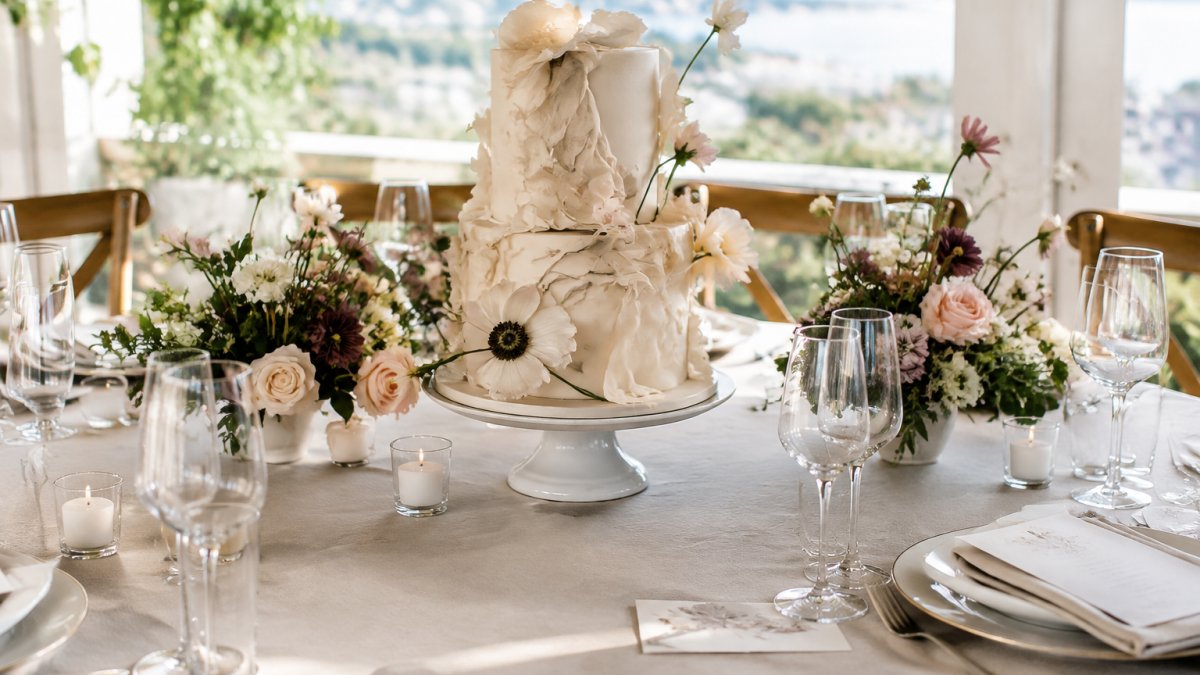
Venue coordination matters here too. Confirm the cake's scale against the table and the room, and check that delivery timing lines up with service. Violet Cake Co can design the cake around your menu and reception space. For more on tying the whole look together, see our guide to creating a cohesive look with luxury wedding cake designs.
Building a Dietary and Allergen Communication System
A dietary system is a written process, not a verbal promise. Food allergies and dietary restrictions need to move from the guest's RSVP to the kitchen to the printed menu without losing accuracy, and the system has to survive last-minute changes.
Build it in five steps:
- Collect needs at RSVP with specific categories, not free text. Offer checkboxes for the major allergen groups and common dietary patterns, plus one open field for anything else. Free-text-only collection produces inconsistent answers that are hard to consolidate.
- Consolidate into a single guest-by-guest sheet shared with the caterer and dessert team. One master sheet, one owner, one version. Note the guest's name, table, the specific restriction, and the approved substitute.
- Mark each affected dish on the final menu with a clear, consistent symbol, and define the symbols in a short key at the bottom of the menu so guests are not guessing.
- Brief service staff on which plates go to which guests, and confirm the plate is delivered to the named guest rather than set at the table for anyone to claim.
- Reconfirm the sheet with every vendor in the final week, and log any change with a timestamp so the kitchen and dessert team are working from the same version.
Cross-contact is the part most hosts underestimate. A dessert team working with gluten, nuts, and dairy in one kitchen needs a written plan for separate tools, surfaces, and storage, and the caterer needs the same discipline for plated courses. Ask each vendor how they prevent cross-contact rather than assuming it is handled.
Watch out: relying on memory or a group chat for allergen information is the most common failure point. One missed note can put a guest at risk, and a verbal change at the tasting rarely reaches the line cook on event night.
Our article on gourmet wedding cakes that honor every dietary need covers how to keep flavor intact when restrictions are in play, and the same labeling discipline applies to every course on the menu.
A Planning Timeline and Budget Framework for Custom Menus
Custom menus need a decision timeline, because the cake, the catering, and the printed layout all depend on final guest counts and confirmed flavors. Work backward from the event date.
- Four to six months out: lock the menu concept, book the caterer and cake designer, and set the budget split.
- Two to three months out: finalize courses, schedule tastings, and confirm dietary needs.
- Four to six weeks out: approve menu copy, send to print, and confirm delivery logistics.
- One to two weeks out: reconfirm counts, allergens, and timing with every vendor.
Budget trade-offs come down to where guests actually notice the difference. Passed bites and the dessert course carry outsized impact; a long printed wine list often costs more than it delivers. For a sense of how these costs add up, see what luxury catering costs per person, and align your cake deadline with our wedding cake lead time rules.
Start Your Cake Design With a Custom Menu in Mind
The menu is the script for the evening, and the cake is its closing line. When the two are designed together, guests experience one coherent idea instead of a series of separate vendors' choices.
That takes a designer willing to work from your menu, your story, and your room. Violet Cake Co brings fine-art training, a signature floral-inspired aesthetic, and hand-crafted sugar florals to bespoke cake centerpieces built around your event. Our flavor-first recipes mean the cake tastes as considered as it looks, and our consultation process walks you from concept to final design.
Start with the menu. Then let us design the cake that finishes it. Get started with Violet Cake Co and explore our cake flavors and tasting options to begin your custom design.
A custom menu only pays off when every element, dessert included, is designed around the same story. Violet Cake Co builds bespoke, sculptural cakes with hand-crafted sugar florals and flavor-first recipes, shaped through a professional consultation and design process. Get started with Violet Cake Co and turn your menu into a centerpiece guests remember.
Frequently Asked Questions
What are the key factors to consider when designing a menu for a private event?
Start with the guest of honor and the guest list: their preferences, dietary needs, and food allergies. Then match the menu structure to the event style, whether that means passed bites for a cocktail reception or a seated multi-course dinner. Consider the event theme, seasonal and local ingredients, and how the printed menu will read. Build in a planning timeline and a budget that accounts for course count, service style, and custom printed menus.
How does a personalized menu enhance the storytelling of an event?
A personalized menu turns food into narrative. Naming a dish after a shared memory, featuring a family recipe, or building courses around a place the hosts love gives guests something to talk about and ties the reception space to a personal story. Menu descriptions, typography, and imagery carry that story onto the page, so the printed menu becomes a keepsake rather than a formality.
Should a custom menu match the event's overall aesthetic?
Yes. Menu layout, typography, and colors should echo the event theme, décor, and reception space so the printed piece feels like part of the design rather than an afterthought. The same principle applies to food presentation and cake design: a sculptural, floral-inspired cake reads best when the menu typography and course descriptions share its restraint and elegance. Coordination across these elements is what makes an event feel intentional.
How do you accommodate food allergies and dietary restrictions without disrupting the menu?
Collect dietary needs during RSVP and confirm them with the caterer and venue well before the event. Build one or two courses that are naturally free of the most common allergens, and mark those options clearly on the printed menu. Brief the catering team on a seating plan that identifies guests with restrictions, and confirm service timing so special plates arrive with everyone else's. A written system beats verbal reminders every time.